
Root canal treatment is the repair of the teeth that have decayed due to infection in the teeth and the recovery of these teeth and the patient is restored to healthy tooth structure. As in every health problem, early diagnosis and treatment in root canal treatment is very important in terms of saving the tooth. Otherwise, it is highly likely that the infection will spread to other teeth by spreading to the surrounding tissues and the teeth will be lost. How to do root canal treatment, whether pain is experienced during and after treatment are among the frequently asked questions.
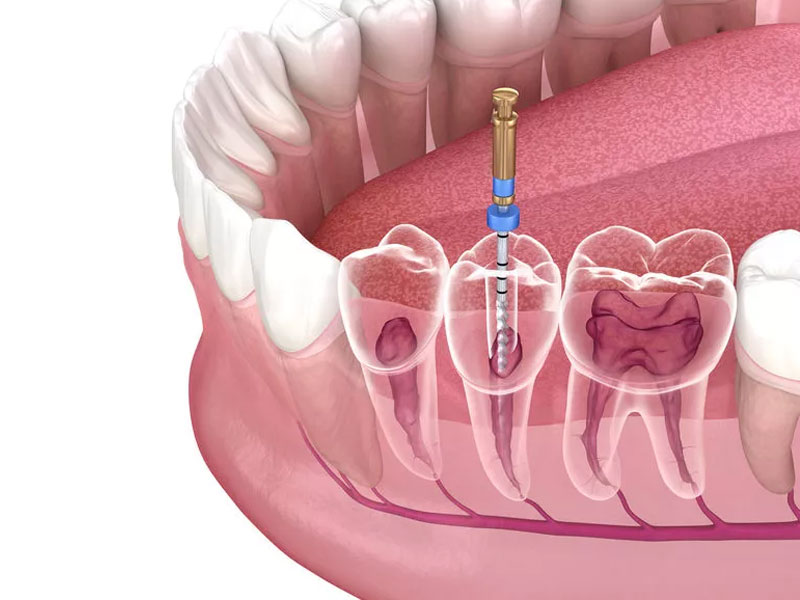
After the first oral and dental examination of our patients who apply to our clinic in order to get rid of the painful situations caused by dental infection, it is understood whether there is a need for root canal treatment. In the treatment of our patients who need root canal treatment, the nerve and tooth pulp of the infected tooth or teeth are taken. Then, the treatment is completed by cleaning the inner part of the tooth and filling it.
How is Root Canal Treatment Performed?
Root canal treatment performed by specialist endodontist physicians working in our clinic starts with the first examination and the X-ray film taken to examine the structure of the root canals. Thanks to the X-ray obtained, it is determined whether the infection formations have started in the bones and, if so, in which teeth.
In the next stage, the tissues around the tooth are anesthetized with local anesthesia and made insensitive to pain. Thus, our patient does not feel any pain during the treatment. After the numbing, a rubber layer is placed around the tooth to ensure that the tooth to be treated and its surroundings remain dry. The next stage of the treatment, which is carried out in a completely sterile clinical environment and performed by specialist physicians, is the removal of rotten nerve tissue and pulp. In order to achieve this, a hole is drilled at the edge of the root and harmful bacteria are removed from the tooth root with the help of root canal rasps.
During cleaning, the residues from the tooth root are completely cleaned of germs and residues by using water or sodium hypochlorite. After the cleaning process is completed, the treatment is terminated by closing the hole opened.
How Long Does It Take To Complete The Root Canal Treatment?
The most curious issue of pain-sensitive patients is the answer to the question of how long the root canal treatment lasts. Although it is known as a painful and painful treatment, root canal treatments performed by specialist physicians by applying the right procedure are performed painlessly and painlessly. Root canal treatment is completed in one or two sessions depending on the damage to the tooth. However, if early intervention is not made and the infection has spread accordingly, the treatment may take three sessions.
The main goal of root canal treatment is to clean the infection accumulated in the tooth and then to fill the gap opened to give the tooth strength and to restore the tooth to a healthy structure. The rubber-based substance called guta percha, which is compatible with the human body and does not cause any reaction, is filled into the cavity opened in the tooth and the tooth is made resistant to external influences. Depending on the patient’s condition, in addition to the guta percha substance, additional mixtures can be used to prevent possible leaks and to fix the tooth.
Is There Pain After Root Canal Treatment?
Since the area is desensitized with local anesthesia during the caries root canal treatment, there is no pain that the patient cannot withstand during the application. Already root canal treatments are carried out for the purpose of eliminating the pain caused by infection in the teeth and saving the tooth. If the patient experiences infection and related pain in the tooth before the treatment begins, he may feel mild pain for a few days after the treatment due to the sensitivity that occurs.
If the painkillers prescribed by our physicians are used in the post-canal treatment process, the patient can start to perform his daily activities smoothly after one day. Even if our patients who have a low threshold of pain and pain resistance during root canal treatment feel discomfort, they get rid of all pain and pains with the removal of inflammation and the completion of the filling.
What Should Be Considered After Root Canal Treatment?
Root canal treatment 2nd stage is the period when the tooth begins to heal gradually. In this period, it is necessary to pay attention to some issues and to ensure that the recovery is completed within the usual time. After treatment,
- To avoid foods that are hard and crusty enough to disturb the female,
- To continue tooth cleaning without interruption, to brush teeth with lighter and circular movements, taking into account possible tooth sensitivity during cleaning,
- Gently cleaning between the teeth with dental floss once a day to prevent new infections that may occur after treatment,
- To interrupt or reduce the consumption of foods such as gum and sugar that stick to the tooth after treatment,
- After the treatment, it is recommended to use drugs such as painkillers or sprays prescribed by the physician without interruption.
In case of non-compliance with the recommended precautions after root canal treatment, there is a possibility that the procedures performed will be unfinished root canal treatment and it is among the possible results that the patient will have more problems in the later stages.
Root Canal Treatment Prices
Root canal treatment prices may vary according to the number of teeth to be treated and the condition of the tooth. In order to get the most accurate prices, you can visit our clinic or contact us at our contact numbers to get all the information you need.